Topic clusters and pillar pages: how to build topical authority
By BeeRanked · June 27, 2026 · Updated September 12, 2026
Two sites publish ten blog posts each. A year later, one pulls in steady search traffic and the other is invisible. The surprising part is that writing quality is rarely what separates them. The difference is shape. One site picked a subject and covered it from every angle, with the pages wired together so each one lifts the rest. The other published ten unrelated posts and hoped. The first site built topical authority.
You build topical authority with a topic cluster, one broad pillar page on a subject surrounded by focused supporting pages that each answer a single sub-question, all linked together. The pillar earns authority for the main term; the supporting pages catch specific searches and pass their authority back to it. This post is how to build one.
What topical authority means
Topical authority is simple to say: it is how thoroughly and credibly you cover one subject. A search engine is trying to decide who to trust on a topic. A site with one thin post about, say, invoicing looks like a dabbler. A site with a clear main guide plus a dozen focused pages on every corner of invoicing, all linked together, looks like it owns the subject. The signal is depth plus connection across the whole neighborhood of questions around a subject.
Why one cluster beats ten orphans
A scattered post is an orphan. It has no siblings to vouch for it, no obvious place in a larger structure, and it asks a search engine to judge it cold. A cluster is the opposite. Each page is evidence that the others belong to a deliberate body of work, and the internal links pass context and authority between them. Ten posts on ten subjects spread your effort across ten fights you are unlikely to win. Ten posts on one subject concentrate it into a single fight you can. Same word count, different outcome.
The anatomy of a topic cluster
A topic cluster, you will also see it called a content cluster or a hub-and-spoke model, has two parts:
A pillar page, the broad, definitive page on the subject. It introduces the whole topic and links out to every supporting page.
Supporting pages, each one going deep on a single sub-question the pillar only touches. They link back up to the pillar and across to their siblings where it helps the reader.
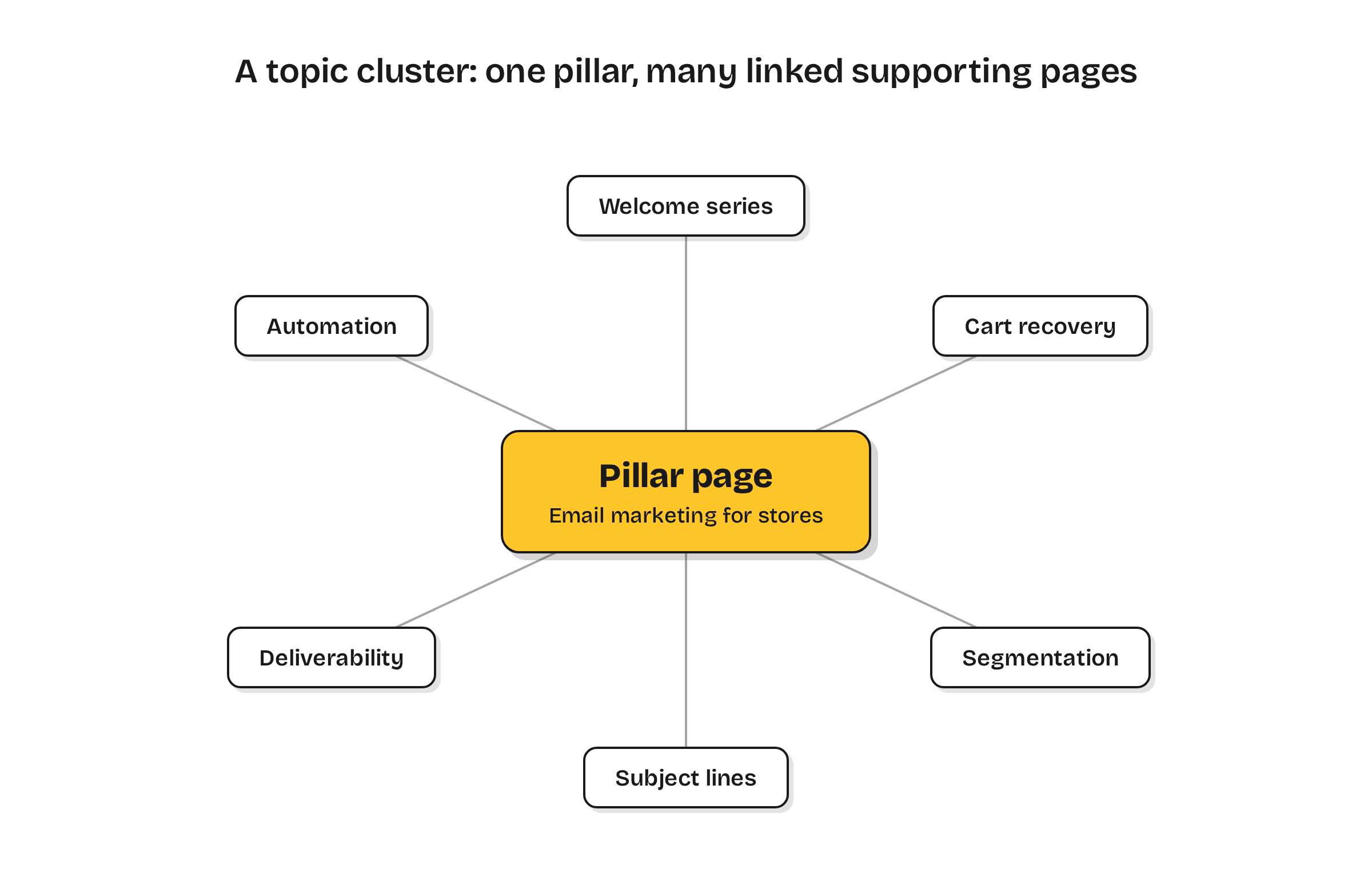
The pillar earns authority for the head term. The supporting pages catch the long tail of specific questions and funnel their authority back to the pillar. Together they cover the topic in a way no single post can.
A worked example
Say you sell software for online stores and you want to own "email marketing for online stores." That broad guide is your pillar page. Around it you publish one supporting page for each question a store owner asks:
a welcome series that turns new subscribers into buyers
recovering abandoned carts by email
segmenting customers by what they have bought
writing subject lines that get opened
staying out of the spam folder, the deliverability basics
automating post-purchase follow-ups
Six focused pages, each able to rank for its own specific search, each linking up to the pillar and across to its siblings where it helps the reader. Together they cover store email in a way a single 1,500-word post never could, and they tell a search engine you are a serious source on the subject.
Internal links are the wiring
A cluster is only a cluster because of the links between its pages. Internal links do two jobs at once: they guide readers to the next logical page, and they tell search engines how your content relates and where the importance sits. A page with no internal links is a dead end. A well-linked page is a junction.
Links rot, though. Rename a page, change a URL, and yesterday's tidy structure fills with broken links. That is where doing it all by hand falls apart at scale, and where it pays to have the wiring maintain itself. Improve your SEO shows where to review how your pages connect.
Pick a topic narrow enough to own
The most common mistake is starting too broad. "Marketing" is not a topic you can own. "Email marketing for online stores" might be. Pick a subject specific enough that a dozen useful pages would more or less cover it, then expand outward once you have earned authority there. It is far better to be the clear best source on something small than the hundredth voice on something huge.
Publish for the questions
Build your cluster from the questions people ask. Every question your customers, your support inbox and your sales calls keep raising is a candidate for a supporting page. Answer each one clearly and answer-first, the same structure that gets you cited in AI answers, and the keywords largely take care of themselves. This is also what makes a cluster useful to humans as well as crawlers: it becomes a resource. For why this beats rebuilding your whole site to "do SEO," see keep your website, grow your traffic.
How to build a cluster in BeeRanked
The product is shaped around this strategy:
Group the cluster with a category. A category collects every page on a subject and gives the group its own archive page that can rank on its own. See organize your content with categories.
Wire it with internal links that maintain themselves. Link your pillar and supporting pages together; when you rename or move a page, the links follow instead of breaking, and a visual graph shows you the shape of your network.
Publish consistently. A cluster is built one page a week. Steady depth is what compounds.
Pick one subject you know, map the questions around it, and start with the pillar. Publish your first page, then add a supporting page next week. In a quarter you will have something a search engine, and a reader, recognizes as authority.
Frequently asked questions
How many pages does a topic cluster need?
There is no magic number. Enough to cover the subject's real questions without padding, often somewhere between five and fifteen to start. Coverage matters far more than the count.
What is the difference between a pillar page and a supporting page?
A pillar page is the broad, definitive guide to the whole subject and links out to everything beneath it. A supporting page goes deep on one narrow question and links back up to the pillar. The pillar targets the head term; the supporting pages target specific long-tail searches.
Is it better to publish a cluster all at once or over time?
Over time, in almost every case. A steady cadence signals an active, living resource and lets you learn from what performs. Publishing everything at once is harder to sustain and easier for search engines to overlook.