Will Google penalize your AI content?
By BeeRanked · July 7, 2026 · Updated September 12, 2026
The fear shows up in every content team: publish something a machine helped write, and Google will bury you. Most of the fear is misplaced. Google's rules target low-quality, mass-produced content built to manipulate rankings, whichever tool produced it, and Google says so in writing.
Using AI to help write content is within Google's rules. Using automation to churn out volumes of thin, unoriginal pages to game Search has been against them for years. Keep a person who knows the subject in the loop, add what only you can add, and publish pages that help a reader. How the words were drafted then makes no difference.
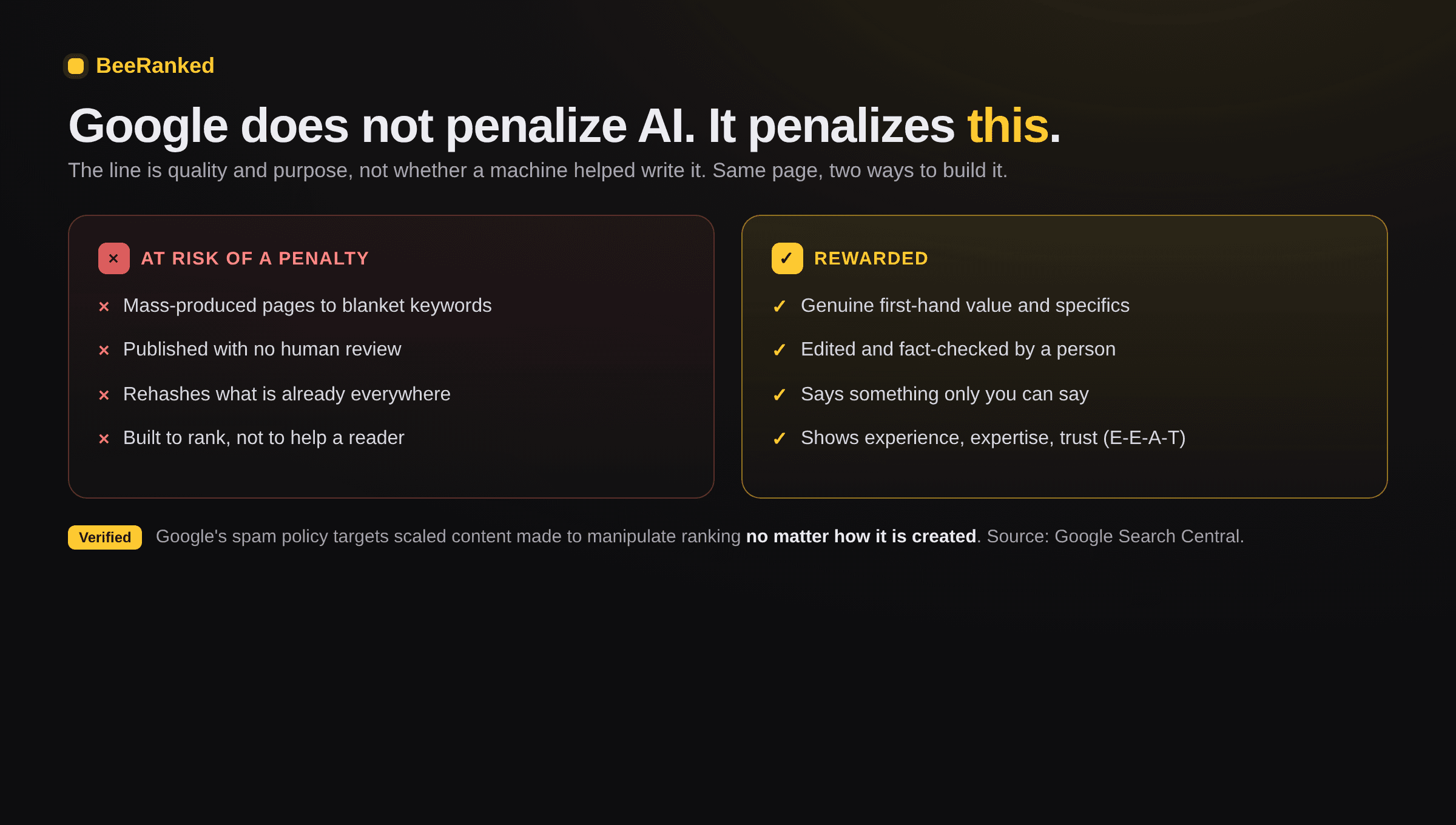
What Google says
You do not have to guess at Google's position, because Google has stated it directly. Its guidance on AI-generated content says that using automation, including AI, to generate content with the primary purpose of manipulating ranking in search results is a violation of its spam policies, and, just as plainly, that "not all use of automation, including AI generation, is spam." What Google rewards is content that demonstrates E-E-A-T: experience, expertise, authoritativeness and trustworthiness. The test is the quality and purpose of the page.
Scaled content abuse
The rule that applies here is scaled content abuse, part of Google's spam policies. It targets many pages generated for the primary purpose of manipulating Search rankings rather than helping users, and it applies "no matter how it's created." Google introduced it alongside its March 2024 core update so it could act on mass-produced junk whether it came from automation, human effort, or a mix of the two. Read the two documents together: the target is thin, unoriginal content produced at scale to rank, whichever tool produced it.
Why AI makes the risk easier to trip
The fear clusters around AI because it removes the friction that used to limit low-quality content. When each page took a person a day, nobody could flood the web with 500 near-identical articles. Now they can, cheaply, and many do. Publishing volume because you can is what walks a site into the scaled-content trap. The rule did not change; it became far easier to break by accident.
How to publish AI-assisted content safely
The safeguards are the same things that make content good however it was drafted:
Keep a human in the loop. Someone who knows the subject edits, fact-checks, and takes responsibility for every page. Unreviewed bulk output is the clearest risk signal.
Add something only you have. First-hand experience, original data, an example, an opinion. If your page only recombines what already ranks, it adds nothing, and Google notices.
Publish to help a reader. The test Google applies is whether the page was made primarily for people or primarily for rankings. Write for the first and you are on the right side of the line.
Consider a light disclosure. Google suggests telling readers how automation was used where it makes sense. It is optional, and it fits the trust the system rewards.
What the March 2024 update showed
When that update landed, the sites that lost the most were the ones running the pattern the policy describes: large volumes of unedited, me-too content. Sites publishing a smaller number of useful, human-reviewed pages, AI-assisted or not, were not the target. The lesson was that quality control makes the difference, which is what Google had said all along.
Where BeeRanked fits
BeeRanked is a tool that helps you produce content, including with AI, so we take this seriously. It is an editor and engine for your content, one page at a time, with structured data and clean formatting. You bring the substance and the review; the machine handles the mechanics of making each page legible to search engines. Nothing publishes that you did not choose to publish. See how we approach SEO, or drive it with AI, where the same discipline applies: a human decides what goes live.
Use AI to write faster, and keep the thinking. Google has said where the line is: helpful versus spam.
Frequently asked questions
Does Google penalize AI-generated content?
No, not for being AI-generated. Google's spam policies target content produced to manipulate rankings "no matter how it's created", and its guidance states that not all use of AI is spam. AI content that is helpful, reviewed, and original is treated like any other quality content.
What does get a site penalized?
Scaled content abuse: publishing large volumes of thin, unoriginal pages primarily to rank rather than to help users. It applies to human-written content too. The trigger is low-quality content at scale.
Do I have to disclose that I used AI?
Google does not require it. It suggests adding background on how automation was used where that makes sense for your readers. It is a courtesy to readers.