Answer Engine Optimization: how to get cited in AI search
By BeeRanked · June 27, 2026 · Updated September 23, 2026
Search is splitting in two. One half still looks familiar: you type a query, you get a page of links, you click. The other half is new and growing fast. Someone asks ChatGPT, Google's AI Overviews, Perplexity or Copilot a question and, instead of a list, gets a written answer stitched together from a handful of sources the model chose to trust. More of your future readers live in that second half every month.
To get cited in AI answers, publish pages that state a clear answer up front, in self-contained passages a machine can lift without the surrounding context, backed by specifics only you have and a machine-legible identity that says who you are. That practice has a name now, answer engine optimization (AEO), sometimes called generative engine optimization (GEO). The rest of this post is how to do each part.
Ranking and being cited
Ranking means winning a position in a list of links. Being cited means becoming one of the three to five sources an AI blends into a single answer, often with a small footnote pointing back to you. The two overlap. A page can sit on page two of Google and still get pulled into an AI Overview because it states a fact cleanly. A page can rank first and get ignored because its answer is buried under 600 words of throat-clearing. AEO optimizes for that second moment: when a machine scans your page looking for something quotable.
What an answer engine is looking for
Answer engines want a few concrete things:
A clear answer it can extract, stated plainly and early.
Structure it can lift, headings, short definitions, lists and steps it can quote without dragging in surrounding context.
Specifics only you have, numbers, named methods, first-hand detail.
Freshness and consistency, a page that is current and agrees with itself.
A legible identity, clear signals of who published this and why they would know.
Hit those and you are easy to quote. Miss them and the model reaches for a competitor who nailed them.
Lead with the answer, then earn the read
The change with the biggest effect is structural: answer the question first, then expand. Phrase a heading as the real question your reader asked, then give the direct answer in the first sentence or two underneath. Only after that do you add the nuance, the caveats, the example. This answer-first shape is what an extraction model is hunting for, and it happens to be better for human skimmers too. Bury the answer and you lose both.
Use the Standalone Passage Test
Before you publish a section, run it through one question we apply to every page: could this passage be quoted on its own, with nothing above it, and still be true and useful? If yes, it passes. If it only makes sense in context, an answer engine cannot safely lift it, and it will reach for a competitor's cleaner passage instead.
Here is the same point written two ways.
Fails the test:
As we saw above, this is exactly why it matters so much, and it is the single biggest reason teams get it wrong.
Passes the test:
Answer engines quote passages that stand alone. A paragraph that leans on "as we saw above" cannot be lifted into an answer, so the engine skips it for one that can.
The second version names its subject, states the claim, and survives being copied into an AI answer with no setup. Write every section to pass.
Be the source
Large models are trained on an ocean of content that already says the obvious thing ten thousand ways. Another "ultimate guide" that rephrases the consensus adds nothing, and it gets averaged into the background. What earns a citation is being the primary source: original data from your own work, a method you use, a specific number, an example with names and outcomes. Say something only you can say, and you become the thing other sources get summarized against.
The trust signals behind a citation
Answer engines triangulate. Before they repeat your claim, they check whether it lines up with what other sources say and whether you look like a credible publisher. So the boring fundamentals still matter: a real, named author with relevant standing, a brand that shows up consistently across the web, and claims that hold up against other reputable pages. You cannot bluff your way into an AI answer the way you might once have stuffed a keyword.
Let the search agents in
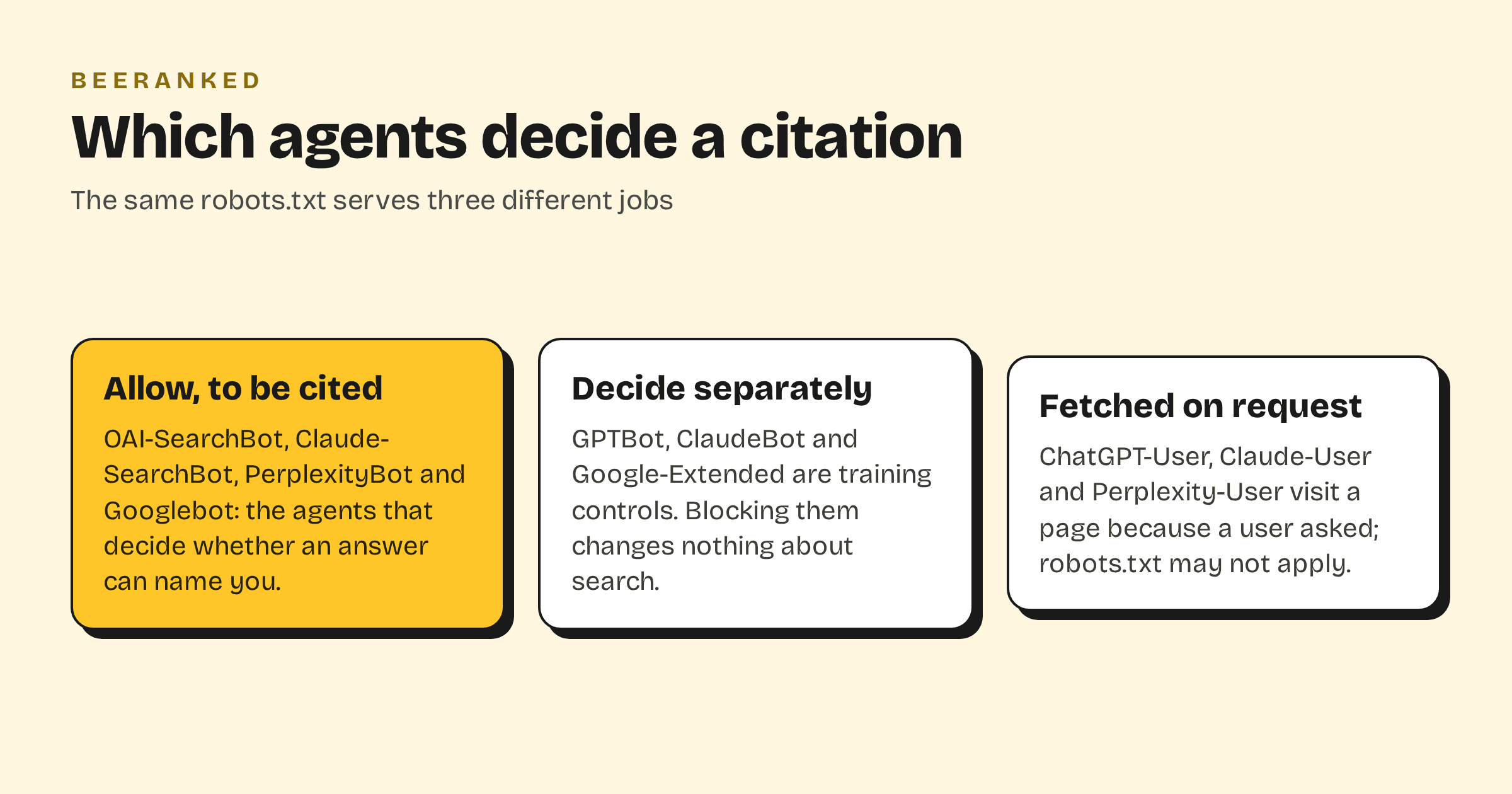
None of the above helps if the engine is not allowed to read the page. The vendors document this with unusual clarity, and they all draw the same line between the agent that cites you and the crawler that trains on you. OpenAI: "Sites that are opted out of OAI-SearchBot will not be shown in ChatGPT search answers", while "a webmaster can allow OAI-SearchBot in order to appear in search results while disallowing GPTBot". Anthropic: disabling Claude-SearchBot "may reduce your site's visibility and accuracy in user search results". Perplexity: "PerplexityBot is designed to surface and link websites in search results on Perplexity. It is not used to crawl content for AI foundation models." Google needs nothing extra, "There are no additional requirements to appear in AI Overviews or AI Mode", and its training control, Google-Extended, "does not impact a site's inclusion in Google Search nor is it used as a ranking signal".
So a robots.txt that blocks AI agents as a group blocks the citations too. Allow the three search agents, decide about GPTBot, ClaudeBot and Google-Extended on their own merits, and check that your host or CDN does not challenge the vendors' published IP ranges. The free AI crawler checker reads your file against the documented list, and Controlling what AI crawlers see walks through the rules.
The identity layer
Great content gets you quoted. A clear identity gets you attributed by name. Answer engines lean heavily on structured data, the invisible layer that tells a machine who you are, what each page is, and how they connect. It is the difference between "one site says" and "according to YourBrand." If you have never seen what machines read from your pages, start with how Google and AI search understand your brand. It is the markup half of the same problem this post covers from the content side.
Cover the whole topic
AEO rewards depth. An answer engine trusts a site that covers a subject thoroughly far more than one that fired off a single post and moved on. That is the same force behind building topical authority with topic clusters: a group of linked pages on one subject earns more citations than a scattered post, because the engine sees a coherent, well-connected source instead of a lucky one-off. Pair answer-first writing with deliberate coverage and you compound both.
Where BeeRanked fits
You can do all of this by hand. BeeRanked makes it the default. Every page you publish is structured answer-first, with clean headings, lists, valid structured data and a consistent brand identity, served from your own domain so the authority compounds in one place. You write the substance, the machine-legibility comes built in. See how we approach SEO, or drive the whole thing with AI if you would rather brief an agent than open an editor.
Ready to put one live? Publish your first page and see how it is structured out of the box.
Frequently asked questions
What is answer engine optimization (AEO)?
Answer engine optimization is the practice of structuring content so AI answer engines, ChatGPT, Google's AI Overviews, Perplexity and Copilot, can understand and quote it. You will also see it called generative engine optimization (GEO). It shares classic SEO's foundation, useful content and clean technical hygiene, but the target is a citation inside an answer.
Will writing for AI answers hurt my Google rankings?
No. Everything that makes a page easy for an answer engine to quote, a direct answer up top, clean headings, real expertise, also makes it better for readers and for traditional search.
How do I know if I am being cited?
Bing Webmaster Tools has had a free AI Performance report since February 2026; Bing says it shows "how often your content is cited in generative answers, with clear visibility into which URLs are referenced". Google folds AI Overviews into Search Console's Web report, with no separate count. For ChatGPT and Perplexity, ask them: How to check whether AI search engines mention your brand has the method, and AEO tools in 2026 the trackers with their prices.