How to find topics worth ranking for
By BeeRanked · July 7, 2026 · Updated September 12, 2026
Most SEO advice tells you how to write a page. Almost none tells you how to pick which page to write, and that is the decision that determines whether the writing pays off at all. You can write a flawless article on a topic nobody searches, or one already owned by sites you cannot outrank yet, and earn nothing for the effort. Choosing the topic well is the highest-leverage step in the whole process. This post is how to do it.
A topic is worth writing when it has search demand, matches what you sell, and is not already locked up by sites out of your league. You find those by starting from your customers' problems, confirming people search for them, reading the intent behind the query, and sizing up the competition. Write the ones in the sweet spot first, and leave the rest.
Start from customer problems
The best topics come from your customers. What do they ask before they buy? What do they get wrong? What do they type into a chat window at 11pm when your product is the answer? Google's own guidance on creating helpful, people-first content starts from the same place: know your audience and write for a need your readers have. Make a list of the problems your product solves, in the words your customers use, and you have a pool of candidate topics before you open a single tool. Support questions are a rich source too, which is why documentation SEO pays off for SaaS teams.
Confirm there is demand
A topic you find fascinating is worthless if nobody searches it. Before you commit, check that the query has search volume, using a keyword tool, Google's autocomplete and "people also ask", or the search box on the communities where your customers gather. You are looking for evidence that the demand exists. This is the step solo founders skip most, and it is why so much startup content ranks for nothing: it answers a question no one asked. Once your own site has traffic, your richest source of proven demand is your own Search Console data, the queries you already appear for. Early on, before you have that, external research fills the gap.
Read the intent behind the query
Two people can type similar words and want completely different things. "Time tracking" might want a definition, a tool, or a how-to. Google decides what to rank by what the searcher intends, so match your page to that intent:
Informational ("how to track billable hours") wants a guide or a clear answer.
Commercial ("best time tracking software") wants a comparison.
Transactional ("time tracking app pricing") wants a product or pricing page.
The fastest way to read intent is to search the query yourself and look at what already ranks. If page one is all comparisons, Google has decided that query wants a comparison, and a definition post will not break in. Write the format the intent demands.
Size up the competition
Search your candidate query and look at who ranks. If page one is wall-to-wall industry giants with a decade of authority, you will not win that term today, no matter how good your page is. It is a later topic. The queries worth your time now are the ones where the current results are weak, generic, or outdated, the ones you can out-answer. The long-tail, specific version of a big topic is usually where that gap lives.
Write the sweet spot first
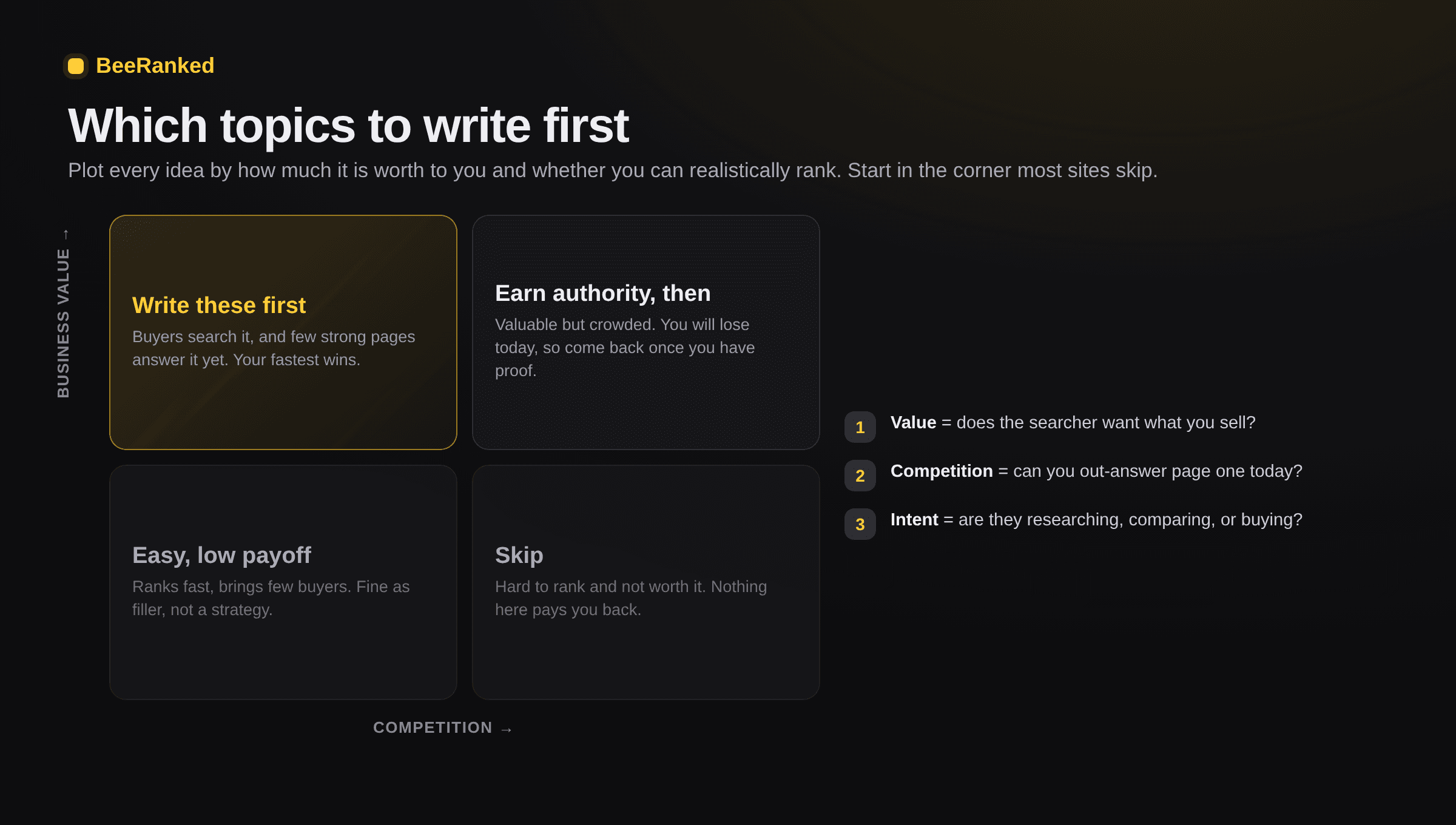
Put it together and every candidate falls into one of four boxes: how much it is worth to you, against whether you can realistically rank. The high-value, low-competition corner is where to start. High-value but high-competition topics are worth it later, once you have earned authority. Low-value topics, easy or not, can wait forever. Spend your limited early effort where a win is both winnable and worth winning.
This also compounds. A handful of focused pages on one subject builds the topical authority that makes the next, more competitive topic in that lane easier to rank for. Topic selection is a sequence: easy wins first, harder ones as your authority grows.
Where BeeRanked fits
Choosing the topic is the judgment call only you can make, because it draws on knowing your customers better than any tool does. What BeeRanked handles is everything after: turning the topic into a page that is structured for Google and AI to understand, written answer-first so it can be quoted, and grouped into a cluster that builds authority over time. You pick the target; the machine makes sure the page is built to hit it. See how we approach SEO.
Pick topics people search, that match what you sell, and that you can win now. Do that consistently and every hour you spend writing works harder, because the page had a chance before you wrote the first word.
Frequently asked questions
How do I find topics if my site has no traffic yet?
Use external signals: keyword research tools, Google autocomplete and "people also ask", and the questions your customers ask in sales calls, support tickets and communities. Your own Search Console data becomes the best source once you have traffic, but early on, customer problems plus a demand check are enough to start.
How much search volume is "enough"?
There is no universal number, and for a young site a low-volume, high-intent query is often better than a high-volume one you cannot rank for. A specific query a ready-to-buy customer types is worth more than a broad one with big numbers and brutal competition. Favor intent over raw volume early on.
Should I target keywords or topics?
Topics. A page built around one narrow keyword is fragile; a page that thoroughly answers a topic naturally covers many related queries and builds authority. Group related keywords into a topic, write the definitive page for it, and link it into a cluster.