WordPress alternative for developers
November 13, 2026
The WordPress alternative a developer wants is different from the one a blogger wants. A blogger wants a nicer editor. A developer wants to stop running PHP for a list of articles, keep the front end in the language the rest of the site is written in, and have an answer when someone asks how the blog gets its sitemap. The Hacker News thread "Is It Time for a WordPress Alternative?" from October 2024 asks whether people are "exploring alternative open-source platforms for pure blogging" (Hacker News), and the answer depends on what you are willing to run. Every price, licence and claim below is from the vendors' own pages, read on 11 October 2026.
What WordPress is, for the record
WordPress is "built on PHP and MariaDB, and licensed under the GPLv2", and "the platform of choice for over 43% of all sites across the web" (WordPress.org). It can be used headless through the REST API, which is "the foundation of the WordPress Block Editor" (WordPress developer docs), or through WPGraphQL, a "Free, Open Source, GPL-3 GraphQL API for every WordPress site" (WPGraphQL). Headless WordPress is a legitimate answer for a team that has a WordPress install already. It keeps the editor writers know. It also keeps the install, which is the part you set out to retire.
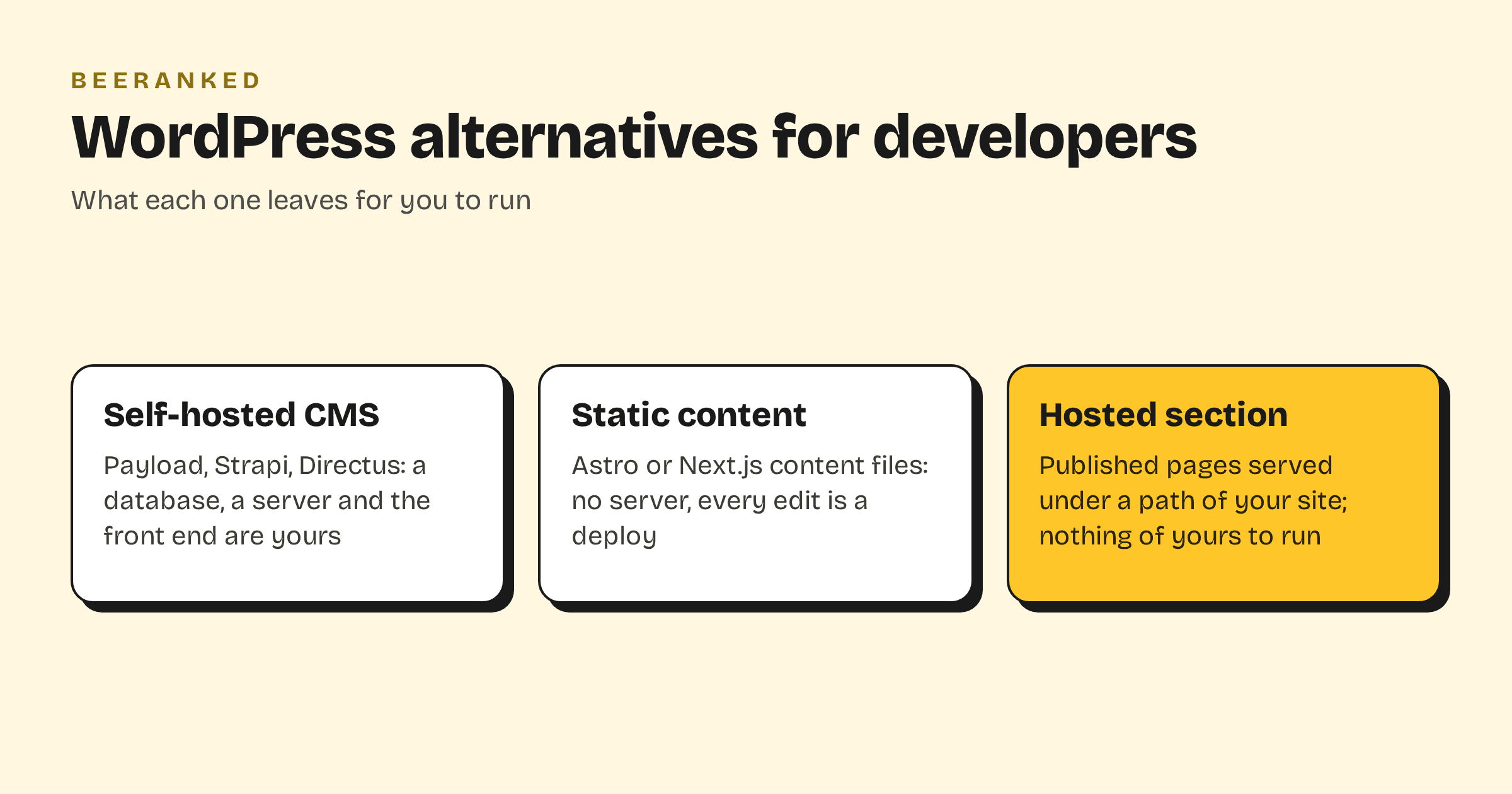
Self-hosted, in your own language
Payload is "the Next.js fullstack framework", MIT-licensed, and adds an admin panel and a database layer to "a new or existing Next.js app" (Payload docs). Since Payload joined Figma, new Cloud deployments are "currently paused", and the company says "Payload remains a self-hosted solution" (Payload). Strapi, in Node, is "Open-Source under MIT License" in its Community edition, with Growth at "$45" a month for three seats, and a managed Cloud from "$35" per project a month (Strapi pricing). Directus is "a backend for building your projects" with REST and GraphQL on top of your database (Directus docs); its Core tier is $0 with a hard limit of "3 user seats", Team is "$499" a month with an annual commitment, and the licence is now the "Monospace Sustainable Core License", with a GPL-3.0 grant that takes effect "on the fourth anniversary" of each release (Directus licence). Ghost is MIT-licensed, written in Node, and can be self-hosted "on just about any VPS hosting provider" (Ghost docs).
Python developers have the same shape of choice: Wagtail and the Django blog packages give you a CMS in Django, and the public pages are yours to template.
With every one of these you have replaced PHP with the language you prefer and kept everything else: a database to back up, a server to patch, an upgrade path to follow, and the rendering layer to write and maintain. The blog's sitemap, structured data, redirects and image sizes are your code.
Static content, with a deploy per edit
Astro content collections and MDX in a Next.js repo remove the server. Keystatic makes those files "editable by humans" with "No database" (Keystatic), MIT-licensed, with a free Cloud tier for three users and Pro from $10 a month (Keystatic docs). Every published post is a commit and a build. For a developer's own blog this is the lightest option there is. For a team with a writer who publishes weekly, each post waits for a build and for a developer's review of a pull request, and the writer soon asks for WordPress back.
A hosted content section, with nothing of yours to run
BeeRanked is the option where the blog is somebody else's server and still your site. The pages are rendered and served under a path of your domain through a rule in the proxy or host you already have, or on a subdomain through one DNS record, or at a BeeRanked address on the free plan. Each page ships as finished HTML with its structured data, sitemap entry, canonical URL, image sizes and translations, and a redirect is created when a URL changes. Writers get an editor with scheduling, developers get a read-only content API and an MCP server for agents, and there is nothing to patch. Standard is $49 a month billed yearly (BeeRanked pricing).
What it is not is a framework. If the content is part of the product, if posts carry custom fields your app reads, or if you want the rendering under version control, a self-hosted CMS in your language is the right tool and BeeRanked is the wrong one. If the blog exists to bring search traffic to a product that is built in something else, the hosted section means the team never writes a sitemap generator.
Side by side
| Feature | Headless WordPress | Payload, Strapi, Directus, Ghost | Astro or MDX with Keystatic | BeeRanked |
|---|---|---|---|---|
| Language | PHP, plus your front end | JavaScript or TypeScript | Your framework | None of yours |
| You run | WordPress plus your app | Database, server, app | A build | Nothing |
| Renders the pages | You | You | Your build | BeeRanked |
| Sitemap, JSON-LD, redirects | Plugins plus your code | Your code | Your code | Included |
| Licence or price | GPLv2; your hosting | MIT (Payload, Strapi, Ghost); MSCL (Directus) | MIT | Free; $49/mo yearly for your domain |
| Writer's editor | Yes | Yes | Yes, through Git | Yes |
Choosing
Run Payload or Strapi when the content model is yours to design and the front end is where you want to spend the time. Run static files when you are the only writer. Run nothing, and mount a hosted section, when the blog's job is to rank and the engineering time belongs to the product. The mount itself, for Next.js, Astro, Vercel, Netlify, Cloudflare and a plain nginx or Caddy server, is in How to add a blog to the website you already have and the pages that follow it. WordPress alternative for blogging on your own domain is the same comparison written for a non-developer.