Model Context Protocol (MCP)
By BeeRanked · August 31, 2026
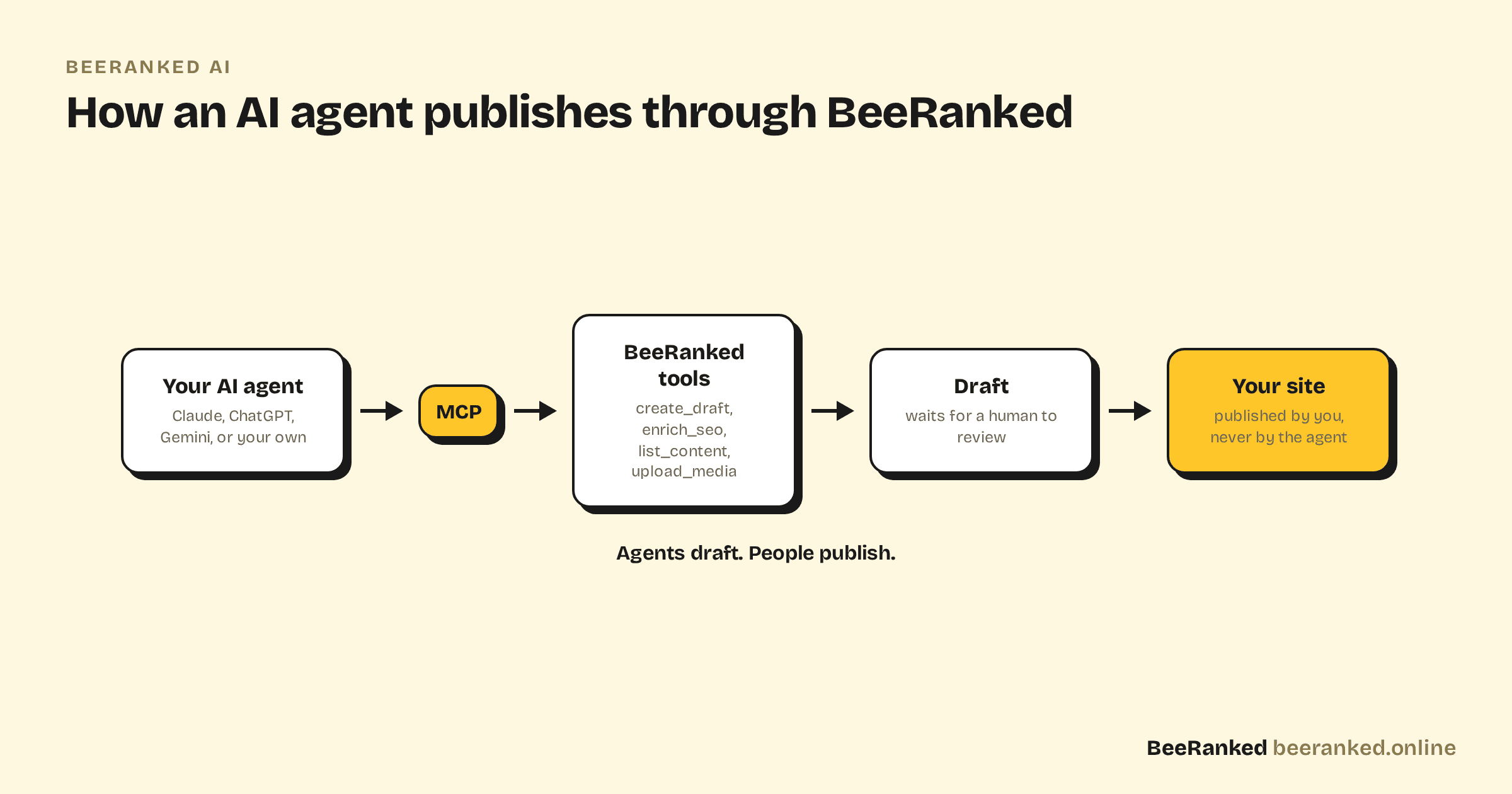
The Model Context Protocol (MCP) is an open standard that lets AI assistants connect to external tools and data sources in a uniform way. Instead of every app building a custom integration for every AI model, an app exposes one MCP server, and any MCP-capable assistant can use it.
Where it came from
Anthropic introduced MCP in November 2024 as an open specification (modelcontextprotocol.io). Adoption moved unusually fast for an integration standard: OpenAI added support across its products in early 2025, and Google confirmed MCP support for its Gemini models soon after. In December 2025 the protocol was donated to a neutral foundation under the Linux Foundation (background), which is the usual end state of a standard that won.
How it works, briefly
An MCP server describes a set of tools, each with a name, a description, and typed inputs. The assistant reads that catalog, decides which tool fits the user's request, calls it, and works with the result. Permissions live on the server side: a server only exposes what its operator allows, to the credentials it recognizes.
Why it matters for websites and SEO
MCP turns "my AI can write" into "my AI can work in my actual systems". For content, that means an assistant can read what exists on a site, create drafts in the right place, and handle SEO fields, instead of producing text that a human has to transport by hand. BeeRanked ships an MCP server for exactly this: agents can draft, enrich, and organize content in your workspace, while publishing stays a human decision. As AI search engines become a real traffic source, the sites that feed them well-structured content will increasingly be doing it through pipes like this one.