How to get mentioned in ChatGPT
By BeeRanked · November 2, 2026
When someone asks ChatGPT for a supplier, a tool or an explanation, the answer may name a company and link to it. Whether that company is yours depends on a few things OpenAI has written down. They are collected here with the matching controls from Anthropic, Perplexity, Google and Apple, since the same robots.txt serves them all. Every quote comes from the vendors' own pages, read in September 2026.
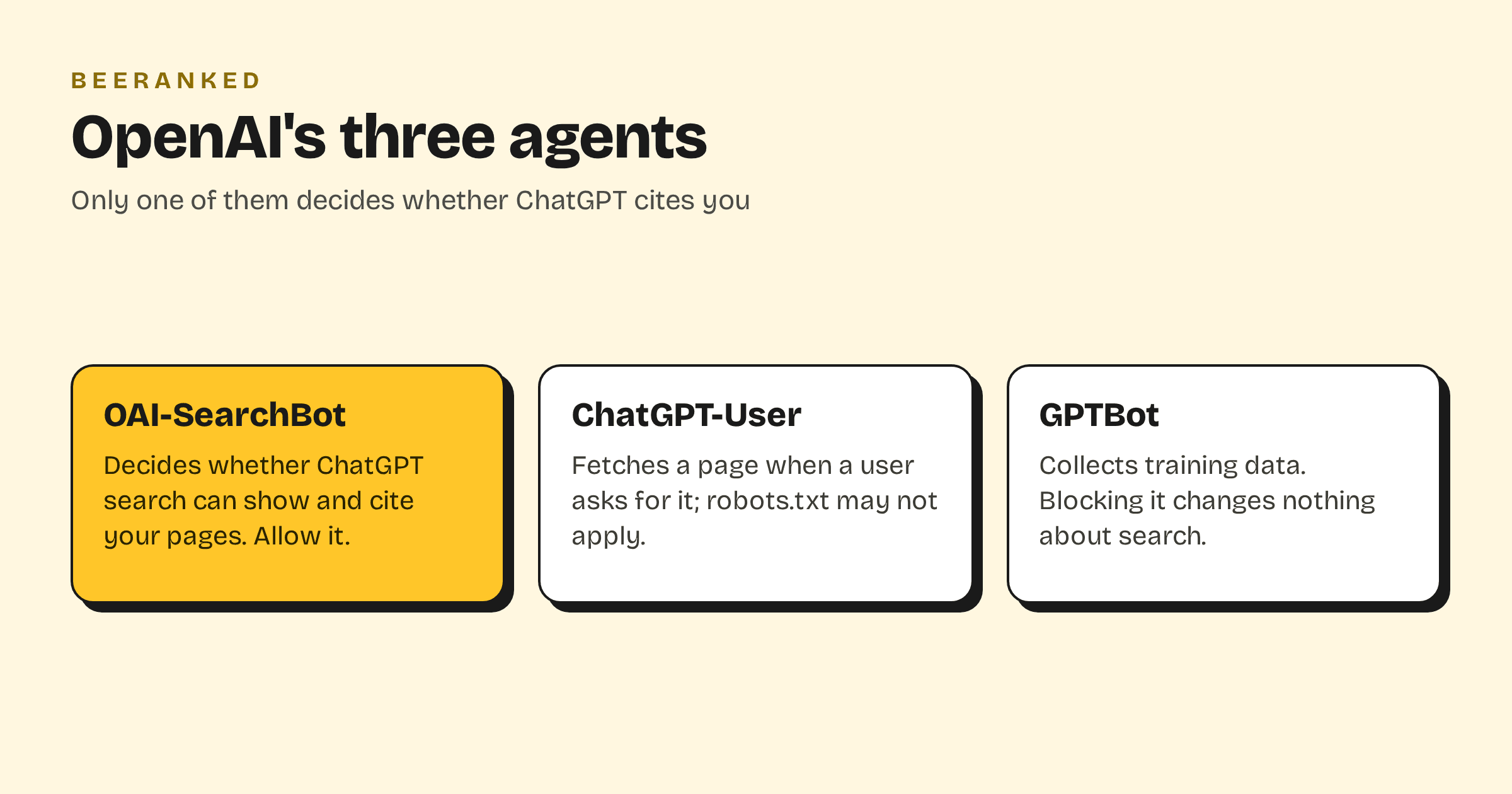
Three agents, one that decides mentions
OpenAI documents three user agents. "OAI-SearchBot is for search. OAI-SearchBot is used to surface websites in search results in ChatGPT's search features." "GPTBot is used to make our generative AI foundation models more useful and safe. It is used to crawl content that may be used in training our generative AI foundation models." And ChatGPT-User "may visit a web page" when a user asks a question; "Because these actions are initiated by a user, robots.txt rules may not apply."
The three are independent. OpenAI's own example: "a webmaster can allow OAI-SearchBot in order to appear in search results while disallowing GPTBot to indicate that crawled content should not be used for training". The consequence for mentions is stated as well: "Sites that are opted out of OAI-SearchBot will not be shown in ChatGPT search answers, though can still appear as navigational links." If your robots.txt blocks AI agents as a group, it blocks the one that gets you cited too. The free AI crawler checker reads your file against the documented list, and Controlling what AI crawlers see walks through the fix.
How ChatGPT search picks its sources
OpenAI's help article Searching the web with ChatGPT sets expectations in two sentences: "ChatGPT ranks search results using multiple factors intended to help users find relevant, reliable information. Placement is not guaranteed." Eligibility is spelled out: "To make a website eligible for inclusion, allow OAI-Searchbot to crawl the site and confirm that the website host or content delivery network allows traffic from OpenAI's published searchbot IP addresses." The list is at openai.com/searchbot.json. A firewall or bot-protection rule that challenges those addresses is a block, whatever robots.txt says.
ChatGPT also uses other people's indexes: "ChatGPT search sometimes partners with other search providers. When it does, ChatGPT search typically rewrites your query into one or more targeted queries that it sends those providers." The providers linked on the page are Microsoft and Shopify. Ranking in Bing is therefore part of ranking in ChatGPT, and Bing Webmaster Tools has reported on this since February 2026: its AI Performance report shows "how often your content is cited in generative answers, with clear visibility into which URLs are referenced and how citation activity changes over time".
If you sell products
The shopping article is more specific. "Product results are selected independently by ChatGPT and are not ads, nor influenced by any OpenAI partnerships." When choosing products, ChatGPT "considers: Structured metadata from first-party and third-party providers (e.g., price, product description) and other third-party content", and merchants "are ranked based on factors like availability, price, quality, and whether they are the maker or primary seller of that item". Shopify stores are covered without extra work: "product data is already integrated into ChatGPT through Shopify Catalog". Other merchants can provide a direct product feed through OpenAI's developer documentation.
Ads do not buy a mention
OpenAI started testing ads in 2026 for the Free and Go plans. Its help article says: "Ads do not influence ChatGPT's answers." and "Ads can appear below the end of a response. Ads are clearly labeled as sponsored and visually separated from ChatGPT's response." There is no paid route into the answer itself.
The same controls at the other assistants
Anthropic uses the same split: "Claude-SearchBot navigates the web to improve search result quality for users", "Claude-User supports Claude AI users", and ClaudeBot collects content "that could potentially contribute to their training". Disabling Claude-SearchBot "may reduce your site's visibility and accuracy in user search results". Perplexity: "PerplexityBot is designed to surface and link websites in search results on Perplexity. It is not used to crawl content for AI foundation models." Google needs nothing extra: "There are no additional requirements to appear in AI Overviews or AI Mode", and Google-Extended, its training and grounding control, "does not impact a site's inclusion in Google Search nor is it used as a ranking signal in Google Search". Apple's Applebot-Extended "does not crawl webpages. Webpages that disallow Applebot-Extended can still be included in search results."
What to do this week
Read your robots.txt for the tokens OAI-SearchBot, Claude-SearchBot and PerplexityBot, and allow them. Decide about GPTBot, ClaudeBot and Google-Extended separately; those are training controls and change nothing about search.
Check that your host or CDN does not challenge the published IP ranges. A challenge page served to OAI-SearchBot is a block.
Give the assistants a page to cite. Our advice: one page per thing you sell, in plain HTML, with the facts an answer needs on it: what it is, who it is for, where you operate, what it costs. How Google and AI search understand your brand covers the entity side.
Track it. How to check whether AI search engines mention your brand covers the manual check and the trackers, and Bing's report is free.
Every page BeeRanked publishes is plain HTML with structured data, and a hub served on a BeeRanked address or a subdomain ships a robots.txt that allows every agent above, so a blog or documentation section on BeeRanked starts on the right side of each rule.