Schema markup that still earns rich results
By BeeRanked · June 27, 2026 · Updated September 12, 2026
Schema markup usually gets added in the hope of a richer search result, and then nothing changes. Google has retired most of the rich results that schema used to earn, and the job of the markup has changed. This post lists what still earns a visible result in 2026, what to emit regardless, and the mistakes that cancel the effort.
The rich results Google already killed
If you are adding schema for a search feature that no longer exists, you are doing unpaid work. Three big ones are gone:
FAQ. Google first cut FAQ rich results back to authoritative government and health sites in August 2023, then removed them from Search entirely as of May 7, 2026. FAQPage markup now produces nothing in search for anyone.
How-to. Google stopped showing How-to rich results on all devices and has since removed the documentation. It is fully deprecated.
Sitelinks search box. Google retired it on November 21, 2024, so the SearchAction you may have bolted onto your WebSite node no longer renders anything.
The leftover markup does no harm and no good, and chasing these is why many "we added schema" projects show zero lift.
What still earns a visible rich result
These are worth marking up because Google still renders them, as long as the underlying data is real and visible on the page:
Breadcrumbs. The most reliable win. BreadcrumbList replaces the raw URL in the result with a clean path. Low effort, high hit rate.
Articles. Article and BlogPosting feed Top Stories and the standard article treatment, and they are how Google attributes authorship and freshness.
Products with reviews. Product markup earns the star result only when it carries a real
aggregateRatingfrom real reviews. No reviews, no stars.Reviews, Recipes, Events, Videos, and Job postings. Each still has a live rich result when the content is that thing.
The survivors describe a concrete thing a user wants to act on.
Why you still emit schema with no rich result in sight
The payoff for structured data has moved from result decorations to machine comprehension.
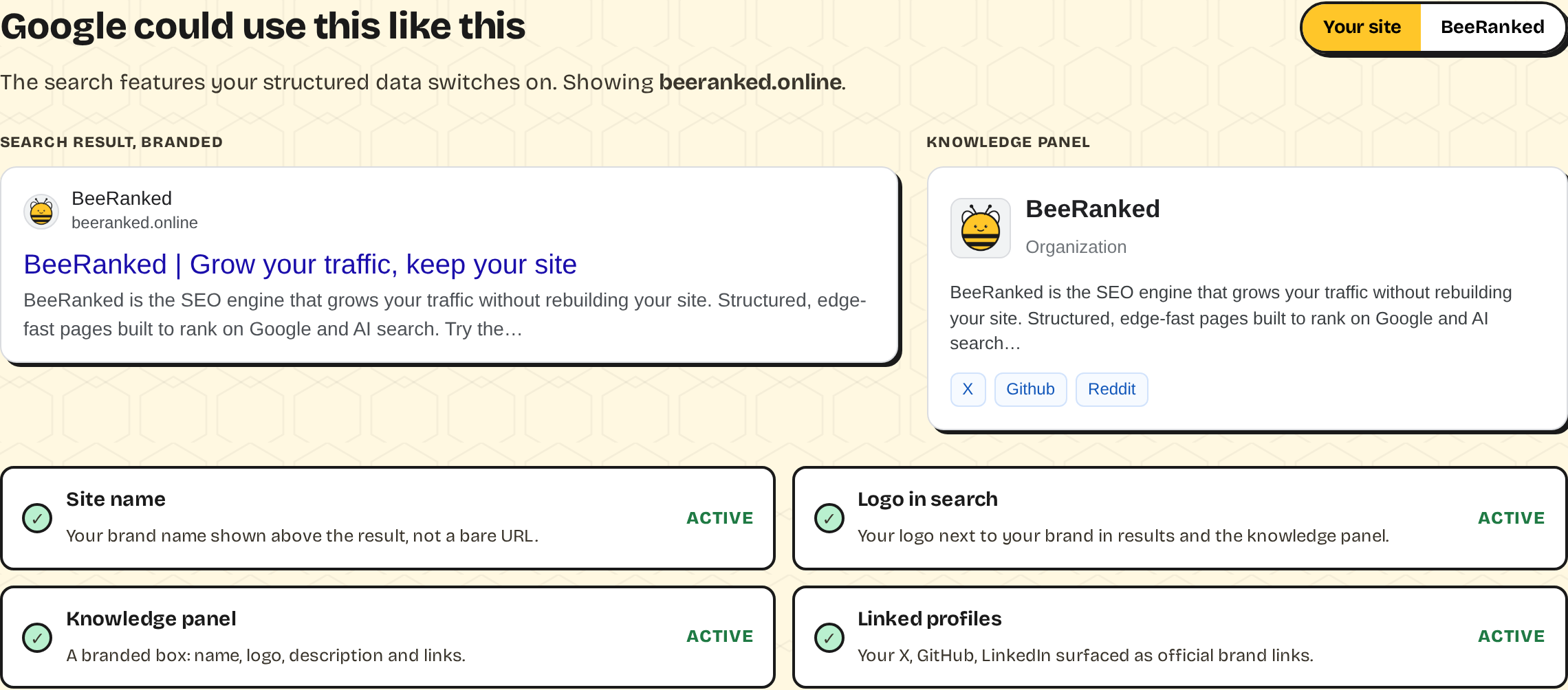
Entity understanding. Organization, WebSite, and Person markup tell Google who you are and how your pages relate, which is how you become a recognised entity instead of a set of loose URLs. I covered this in how Google and AI search understand your brand.
AI search. AI Overviews, ChatGPT, and Perplexity lean on clean, well-marked content to understand and cite a page. Structured data is one of the clearest signals you can hand them, which is the premise of answer engine optimization.
The schema you emit today does double duty: a shrinking set of search features, and a growing set of machines that read your markup to decide whether to cite you.
The mistakes that break your markup
Valid-looking schema fails all the time for boring reasons:
Relative URLs. Every
url,logo,image, and@idin your JSON-LD has to be an absolute, public URL. A root-relative path is invalid to Google and gets ignored.Marking up content that is not on the page. Schema has to match what a visitor sees. Describe a rating or a price that is not visible and Google drops the markup, or issues a manual action.
Inventing reviews. Never fabricate an
aggregateRatingto force stars. It is the fastest route to a structured-data penalty.Letting a plugin emit a generic Organization and nothing else. That covers the entity basics and leaves every article, breadcrumb, and product unmarked.
How to do this without hand-writing JSON-LD
You should not be authoring schema by hand for every page. In BeeRanked, each content page emits Organization, the correct Article type, and a BreadcrumbList automatically, with every URL absolutized to your public host, so the two things that still matter, entity signals and article treatment, are covered by default. The setup is in improve your SEO.
Then verify. Run any page through the free structured data analyzer to see what Google and AI models extract from it, which schemas are present, and where the gaps are. Reading the output beats trusting that the markup is there.
Checklist
Stop chasing rich results Google has already retired. Emit BreadcrumbList and the correct Article type for the features that remain, Organization and WebSite for entity and AI understanding, and Product, Review, Event, or Recipe only where you have the real data behind them. That is the markup that still earns something in 2026, on the results page and in the models that increasingly sit in front of it.