How Google and AI search understand your brand (and what most sites get wrong)
June 23, 2026
Search engines and AI assistants do not read your website the way you do. They look for structured data: a small, invisible layer of code that spells out, in plain machine terms, who you are, what you do, and how everything on your page connects. Get it right and Google can show your brand with a logo, a knowledge panel, star ratings and more. Leave it out and a machine is left guessing from your raw text.
Here is what that layer actually does, why some of the biggest sites on the internet barely bother with it, and why that is good news for you.
What a machine sees when it reads your page
When you look at a homepage, you see a logo, a headline, a few buttons. A search engine sees HTML, and increasingly it hunts for one specific thing inside it: structured data, usually written as JSON-LD following the shared vocabulary at schema.org.
That code answers questions your design implies but never states outright:
Is this an Organization, and what is its name, logo and description?
What official profiles (X, GitHub, LinkedIn) belong to this brand?
Is this page an Article, a Product, an Event, a piece of software?
How do the pages relate, what is the breadcrumb path?
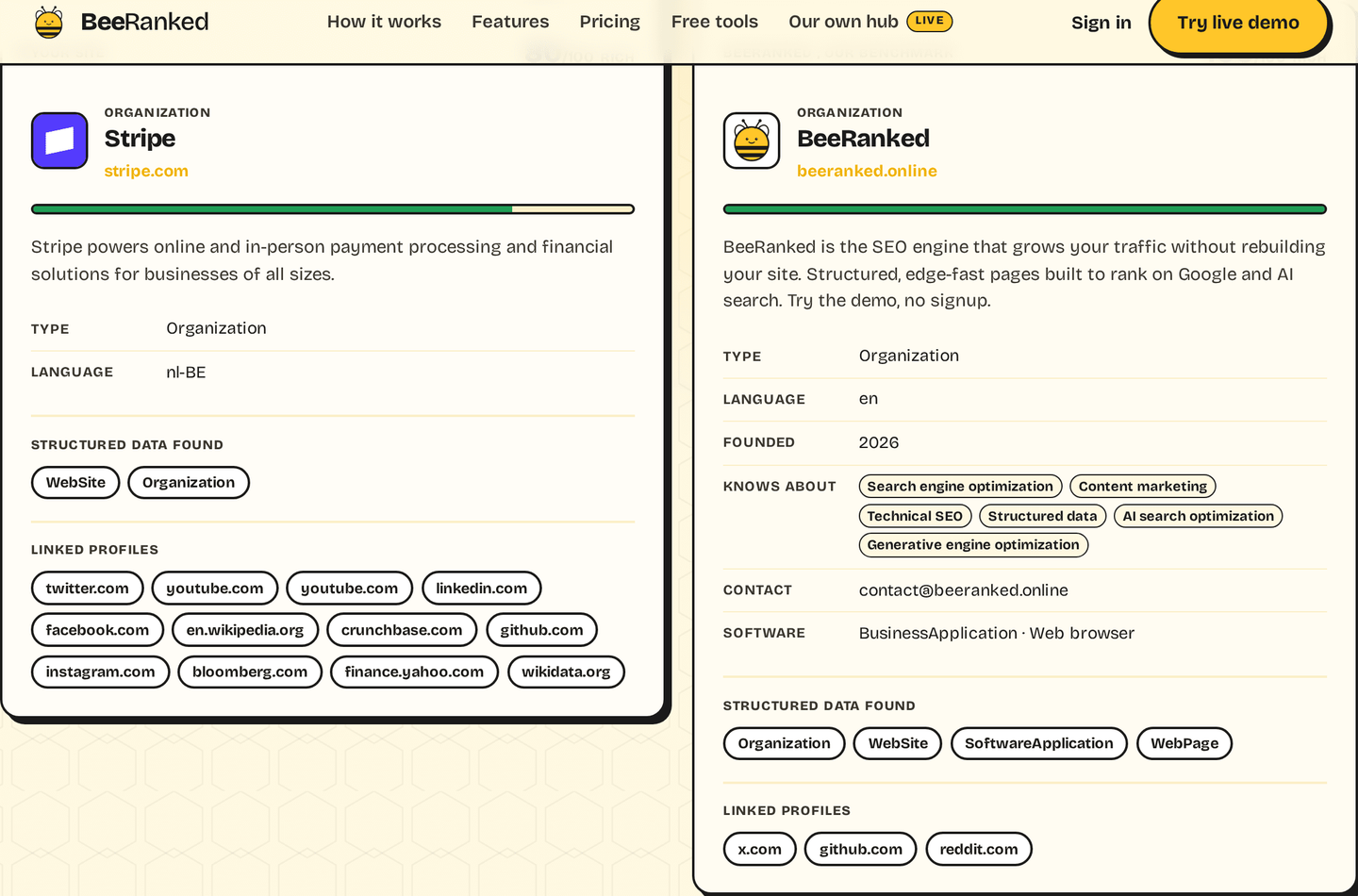
Answer those clearly and you stop leaving your brand's identity to chance. We built a free tool that shows exactly what a machine pulls from any URL, side by side with a fully marked-up page.
Why big brands barely bother (and why that helps you)
Run a giant like Stripe through the same check and you might be surprised: its homepage carries fairly little structured data. That is not an oversight. It is a choice, and it reveals how this actually works.
Google already knows exactly who Stripe is, from two decades of links, brand searches and authoritative sources like Wikipedia and Crunchbase. Stripe's knowledge panel is already full. Adding more markup to its homepage would tell Google something it knows cold. The return is close to zero, so Stripe spends its effort on the pages where a rich result changes clicks: products, pricing, docs.
You do not have that luxury, and that is the point. The whole job of this markup is to establish an entity a search engine is unsure about. When you are not yet a household name, structured data is one of the few levers you have to get recognised, to claim your own knowledge panel, and to stand out in results before you have the backlinks the giants take for granted. It is leverage for the underdog, not the incumbent. Stripe does not need it. You do.
The search features it switches on
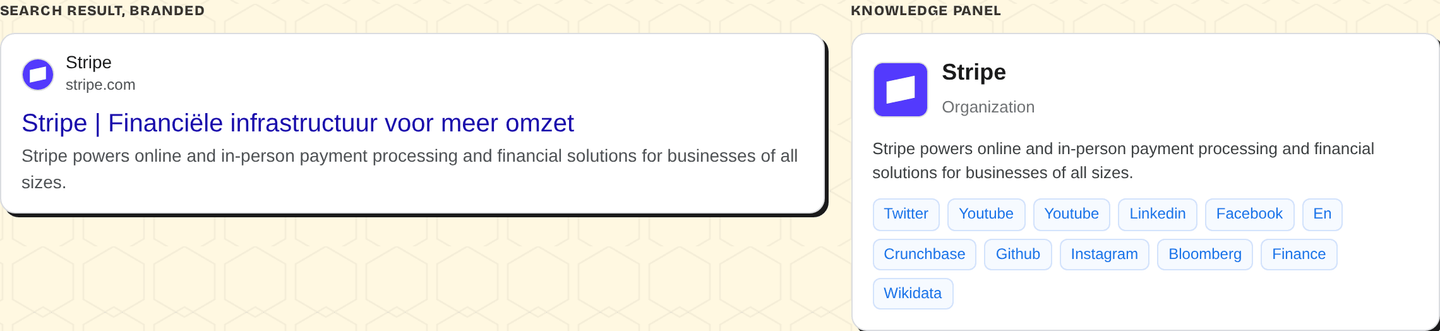
Structured data is not decoration. Each type unlocks a specific way your brand can appear in search, what Google calls rich results.
A few of the big ones:
Knowledge panel, the branded box with your logo, description and linked profiles.
Logo and brand name, shown above the result instead of a bare URL.
Breadcrumbs, a clean Home, Section, Page path in the result.
Review stars, prices and app cards, when you have genuine ratings and offers.
Article results, headline, image and date in Top Stories and Discover.
Not every one applies to every site, a SaaS landing page is not a recipe, and that is fine. The goal is to switch on the ones that fit what you actually publish, not to chase a perfect score.
And now AI search reads it too
This used to be only a Google story. It is bigger now. AI assistants and answer engines lean heavily on structured signals to understand and cite brands. When someone asks an AI tool about your space, the brands it can parse cleanly, their name, what they do, how they connect, are the ones it can confidently mention. Vague, unstructured pages get skipped. Being machine-legible is quickly becoming the price of being included in AI answers at all.
What to actually do
You do not need to hand-write JSON-LD. You need to make sure the basics are present and correct:
1. Identity. An Organization block with your name, logo, description and your real social profiles.
2. The site itself. A WebSite entity, so the site is a named thing, not just a URL.
3. Your content. The right type on the right page (Article on posts, the appropriate type elsewhere), plus breadcrumbs.
4. Keep it honest. Never fake ratings or reviews; it violates Google's guidelines and can earn a manual penalty.
The fastest way to see where you stand is to look. Our free structured data analyzer shows what a machine understands about your brand right now, and exactly which search features you are leaving on the table.
And if you would rather not think about any of this: every page BeeRanked publishes ships complete, valid structured data automatically, that is the point of an engine. See how we approach SEO, or how you can drive it all with AI.
Frequently asked questions
Do I really need structured data to rank?
It is not a magic ranking boost, and it will not save weak content. But it is how you earn rich results and how search engines and AI tools recognise your brand as a clear entity. For a site that is not yet well-known, that recognition is hard to get any other way.
Will it work for AI search, not just Google?
Yes, and arguably more so. AI answer engines rely on clean, structured signals to understand and cite brands, so machine-legible pages have an edge in exactly the direction search is heading.
Can I just copy a big brand's setup?
Be careful. Big brands deliberately keep homepage markup lean because they no longer need it. Copying their minimalism would skip the very thing that helps a smaller brand get recognised in the first place.